
One gesture, two actions
The click that moves a shopper forward can also tell you why they are moving. That is the whole idea, and it is what seven U.S. patents cover.
Filters were never going to be enough
New York City has around 1,300 hotels. A traveler might choose between more than a hundred characteristics: price, neighborhood, a crib, an on-site restaurant, a late checkout.
On a major booking site, reaching the full filter menu takes roughly five page-lengths of scrolling, and even then it covers about twenty of those hundred categories. So shoppers rarely express what they actually want, and retailers never learn it.
The gap is not a ranking problem. It is a data problem: nothing in the funnel ever asks, at the only moment the answer is fresh.
- 1,300
- hotels in New York City alone
- 100+
- characteristics a traveler might choose between
- 20
- of those categories reachable in a typical filter menu
The same bar, doing two different jobs
A traveler is looking at a four-star place by Mount Morris Park. It is close, but not right. Here is what the top of that screen offers them.
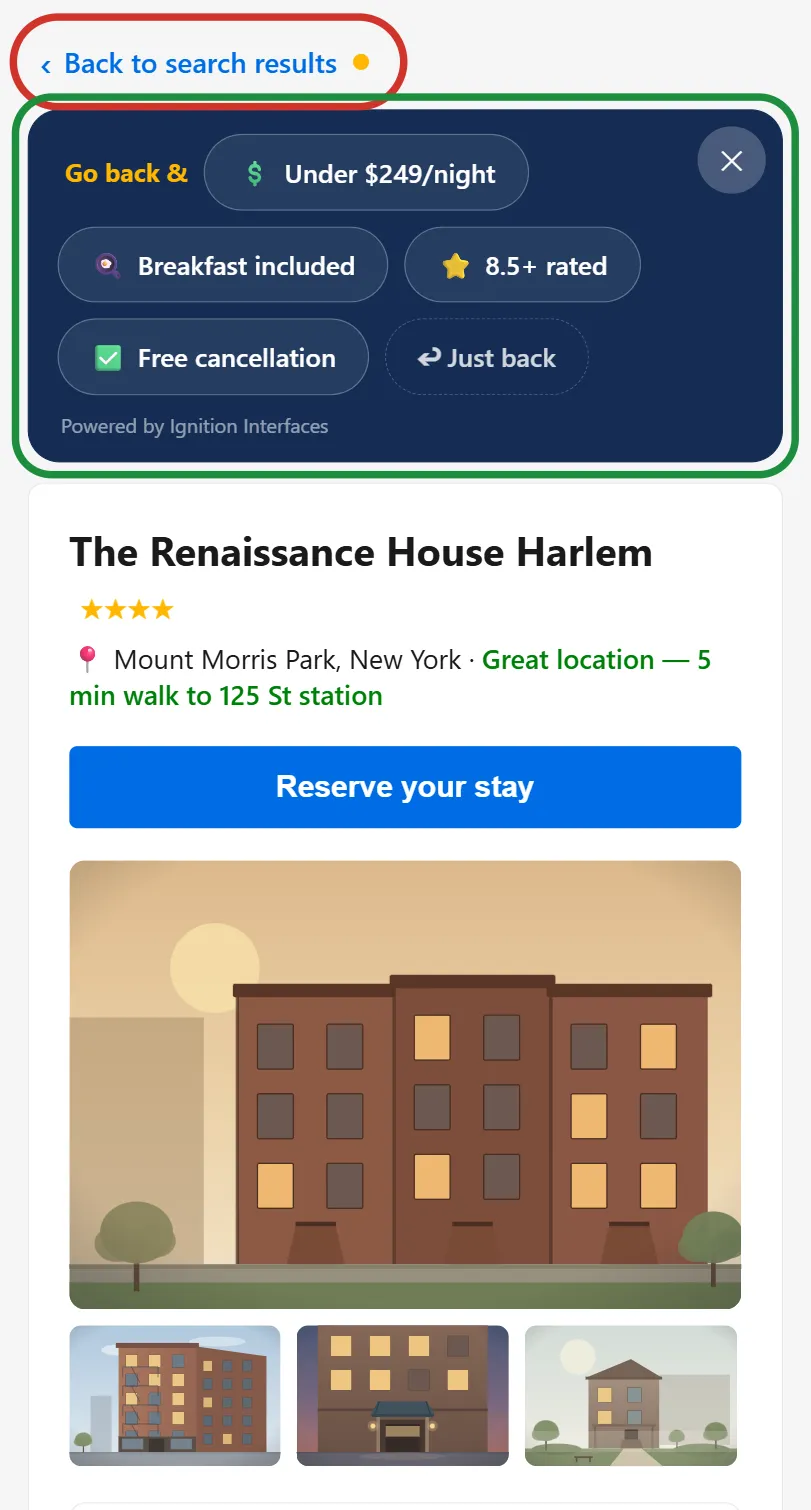
The red circle — an ordinary back
One click returns the shopper to the full list of hotels, exactly as a normal back arrow would. Nothing is taken away. If they want the old behavior, it is still there.
The green circle — the second action
A short set of options, generated for this hotel from what it actually is: its price, its rating, what it includes. A click on any of them returns a shorter, edited list. It also feeds the shopper's explicit choice back to the AI, so the next set of options is sharper still.
Note the last one, Just back. Giving a reason is never compulsory, and declining is one tap.
Every click doubles as a labeled data point: the clean, explicit signal AI learns best from.
Three seconds, start to finish
The shopper reaches a dead end
They have opened a product, looked at it, and decided it is not the one. Right now they know exactly why. In a second that reason will be gone.
The same control offers a reason
The control they were already going to use presents a small set of options generated from the item in front of them: less expensive, different neighborhood, must have a gym.
One click does both jobs
The click returns them to a shorter, better list. It also records the reason as a labeled, first-party data point. No form. No survey. No extra step.
One click, and the loop closes
The gesture does not just shorten this search. It improves the next one, for this shopper and for everybody after them.
A shopper rejects an item
They know exactly why. Today that reason evaporates.
“Too expensive” is recorded
Captured as a labeled, first-party record against the item.
Your AI reads a statement
The shopper’s own terms, not an inference drawn from behavior.
A shorter, better list
And the next set of options is sharper still.
Every interaction feeds the next one. The options get sharper the more the shopper uses them.
What actually gets captured
Not a session recording. Not a heatmap. Not a satisfaction score collected three days later. Four fields, recorded at the moment of the decision.
It is preference data, not personal data. It captures what a shopper wanted, not who they are.
What they rejected
The specific item in front of them at the moment of the decision.
Why they rejected it
In their own terms: price, location, an amenity, a feature. Not an inferred guess.
What they wanted instead
The refinement they chose, which is a direct statement of preference.
What happened next
The shorter result set the choice produced, and whether it ended the search.